
Beyond Electrolyzers: Building India’s Complete Green Hydrogen Value Chain

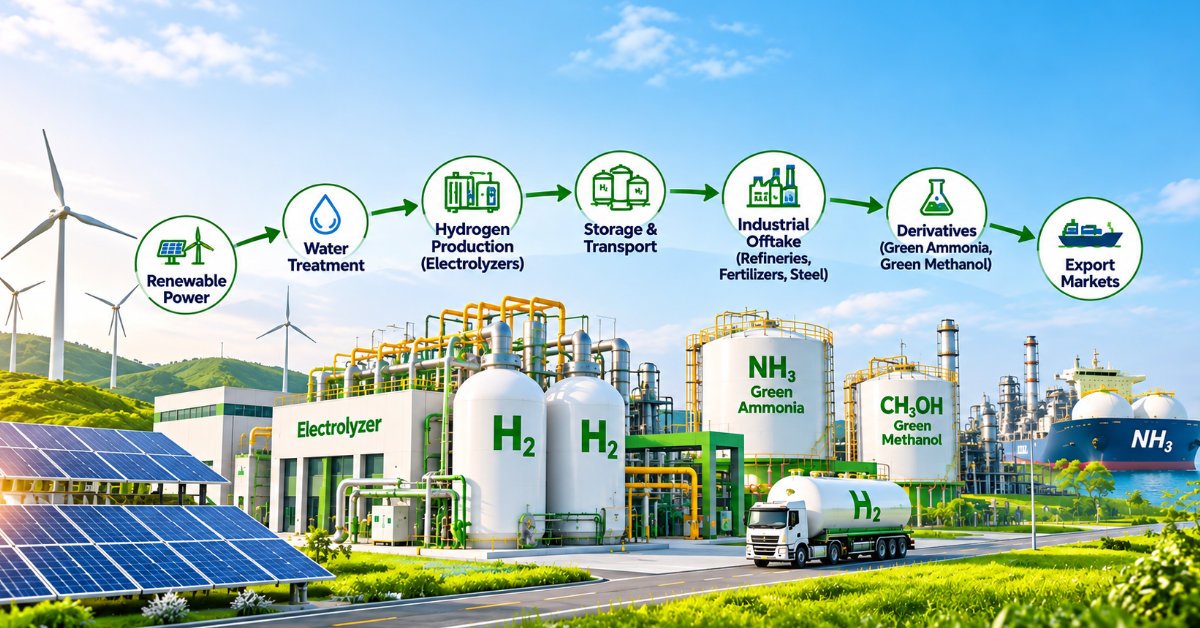
India’s green hydrogen story has entered a more mature phase. The first wave of discussion was dominated by electrolyzers, manufacturing capacity, and production targets, but the real opportunity now lies in building an integrated value chain that can connect renewable power, water, conversion, storage, transport, offtake, and export into one commercially credible system. That shift matters because the winners in this sector will not be defined by technology alone, but by the ability to engineer a reliable industrial ecosystem around it.
The National Green Hydrogen Mission has made the direction of travel clear. India’s ambition is to become a global hub for the production, use, and export of green hydrogen and its derivatives, with a target of 5 million tonnes per annum by 2030 and around 125 GW of additional renewable energy capacity linked to that ecosystem. Yet policy intent is only the first step. As of February 2026, around 8,000 tonnes per annum of green hydrogen production capacity had been commissioned in India, which shows that the sector is still at an early commercial stage and must now move from announcements to bankable execution.
That is why the conversation must go beyond electrolyzers. Electrolyzers are important, but they are only one part of the chain. The real challenge lies in system integration. Green hydrogen is a system business, and the system must include low-cost renewable electricity, land, water treatment, and desalination where required, balance of plant, compression, storage, safety systems, transmission infrastructure, and long-term offtake agreements. Without these components working in alignment, capacity risks remaining stranded or underutilized, limiting real commercial value.
Equally important is the economics of scale. The levelized cost of green hydrogen remains highly sensitive to renewable power tariffs, electrolyzer utilization rates, and the cost of financing. While early bids in India ₹397 per kg for IOC and ₹387 per kg for BPCL and HPCL, indicate that price discovery has begun, achieving global competitiveness will require sustained declines in electrolyzer costs, higher plant load factors, and access to low-cost capital. In this context, financing frameworks and risk-sharing mechanisms will be just as critical as technology deployment.
The International Energy Agency’s Global Hydrogen Review 2024 is particularly relevant here because it shows that the sector’s challenge is not simply about producing more hydrogen, but about advancing infrastructure, policy, investment, and end-use demand at the same time. In other words, the hydrogen economy does not scale by technology procurement alone. It scales when the surrounding industrial architecture is ready to absorb, move, store, and monetize that hydrogen.
India’s next advantage will come from thinking in clusters, not silos. Hydrogen projects need to be anchored near demand centres such as refineries, fertilizer units, steel facilities, petrochemical plants, and chemical manufacturing hubs. That reduces transport complexity, improves economics, and makes it easier to integrate renewable power with industrial offtake. This cluster-based approach also supports supply chain localization and strengthens industrial resilience, both of which are critical for long-term competitiveness.
Green ammonia will be one of the most important connectors in this value chain. It is easier to store and ship than hydrogen itself, and it offers a practical route to decarbonize fertilizer production and support export markets. Green methanol also deserves serious attention, especially for shipping and chemical applications where direct electrification is difficult. The Energy Transitions Commission has argued that clean hydrogen will be essential in sectors where direct electrification is technically challenging or economically inefficient, and that logic extends naturally to hydrogen derivatives as tradeable industrial molecules.
This is where execution capability becomes a competitive moat. Companies that can deliver integrated EPC, manage multi-disciplinary industrial interfaces, and understand both process engineering and project delivery will shape the market. Nuberg Green Energy is one of the companies building in that direction, with capabilities spanning hydrogen production, storage, dispensing utilization, green ammonia, green methanol, and industrial project execution. Its strengths include single-point EPC solutions, advanced engineering, global project delivery, and state-of-the-art manufacturing support, capabilities that are increasingly critical as the sector moves from concept to scale.
From an execution standpoint, the industry is already beginning to see this shift take shape. At Nuberg Green Energy, the focus is on building integrated hydrogen ecosystems rather than isolated production units, linking generation with storage, downstream utilization, and industrial integration. Such an approach not only improves project viability but also accelerates the transition from pilot-scale deployments to commercially scalable infrastructure, which will ultimately define leadership in this sector. From a global perspective, competition is intensifying. Regions such as the Middle East, Australia, and parts of Latin America are rapidly positioning themselves as low-cost hydrogen producers, backed by abundant renewable resources and supportive policy ecosystems. For India to remain competitive, it must leverage its strengths in engineering, cost optimization, and industrial integration while accelerating execution timelines and ensuring cost competitiveness.
From a business perspective, the commercial logic is becoming clearer. India already has a policy framework, a growing base of renewable energy, and emerging domestic manufacturing capabilities. What it now needs is the disciplined creation of demand, infrastructure, and industrial linkages.
For industrial buyers, the message is straightforward. Green hydrogen will not scale because it is a clean molecule. It will scale because it becomes a dependable industrial input. That means the sector must be judged not only on production capacity, but on whether it can support continuous operations, long-term offtake, and logistics that match the needs of real plants. The companies that understand that difference will build stronger positions than those that treat hydrogen as a standalone asset class.
India has a genuine opportunity to lead, but leadership will come from integration, not isolation. The next chapter of the green hydrogen market will be written by organizations that can connect renewable energy to industrial demand through robust engineering, sound economics and disciplined execution. In that sense, the phrase “beyond electrolyzers” is not just a title. It is the real test of whether India can build a complete green hydrogen value chain that is competitive, scalable, and export-ready.


Comments are closed.