
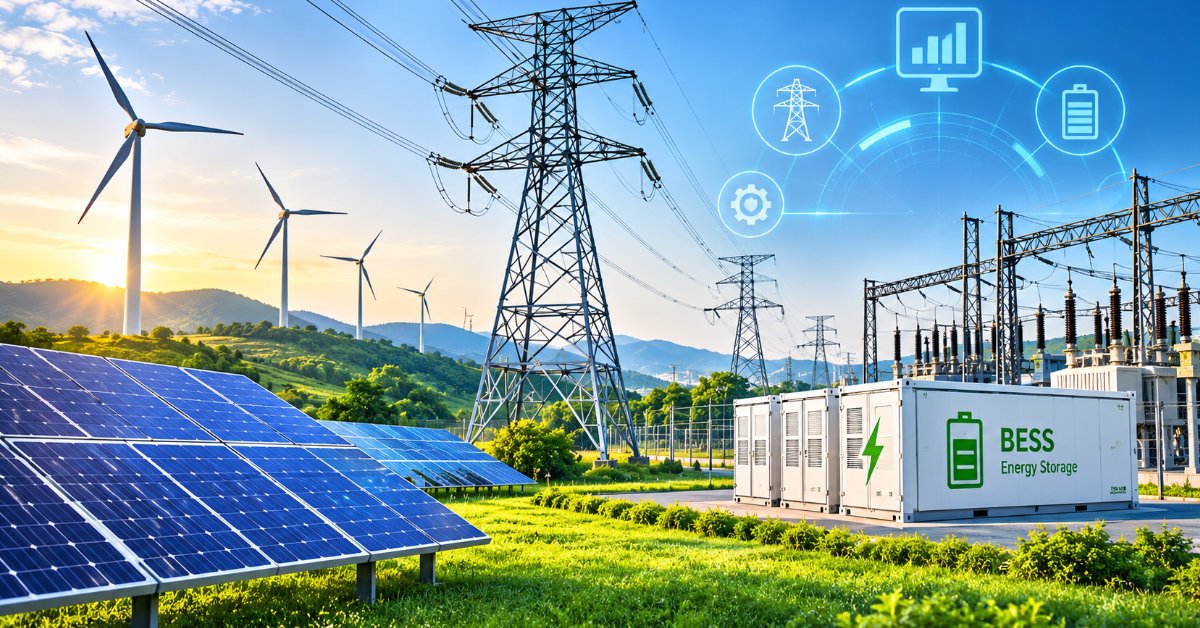

India’s energy transition has entered a decisive phase. We have moved from an era where the primary objective was to generate more power and extend electrification to one where we are building a high-capacity, reliable, flexible and increasingly intelligent power system. At KEC International, our work across power transmission and distribution, renewable energy and associated infrastructure gives us a close view of how these requirements are evolving.
Stay updated with the latest developments in the clean energy sector. Read more in our Solar Energy News India section.
The next challenge is clear: Building India’s Power Grid for Renewable Energy Integration
As renewable generation expands, it is increasingly being developed in resource-rich regions that are often far from consumption centres. This is making the grid more complex, with transmission infrastructure required to carry larger volumes of power across longer distances and diverse terrains. For companies such as KEC, which build critical power infrastructure across geographies, the focus is no longer only on power evacuation, but also on grid stability, reliability and resilience.
India is now moving towards more than 900 GW of non-fossil capacity by 2035. The approval of the ₹1.86 lakh crore Green Energy Corridor III is an important step in this direction, supporting the evacuation of 135 GW of renewable power.
For KEC, this represents an opportunity aligned with our long-standing participation in India’s power infrastructure development. We see the opportunity across the energy ecosystem, from renewable generation and transmission to the infrastructure required for storage, grid balancing and connecting clean energy with emerging centres of consumption. Our integrated EPC capabilities position us to contribute to this evolving infrastructure landscape.
The grid must become more intelligent
India has progressively moved towards higher-voltage systems with 400 kV and 765 kV transmission becoming critical for moving large volumes of power over longer distances. As renewable penetration rises, however, simply adding transmission capacity will not be enough.
The grid will need to become more flexible and intelligent. Technologies such as HVDC, STATCOMs, FACTS, digital substations, automation and advanced grid-management systems will play an increasingly important role. In urban and densely populated areas, where right-of-way is increasingly constrained, underground EHV cabling and GIS solutions will also become more important. For KEC, this shift reinforces the need to look at power infrastructure as an interconnected system, supported by engineering expertise and reliable execution.
This is an area where the industry must think beyond individual assets. For KEC, the opportunity lies in helping build an integrated infrastructure network that connects clean energy generation with new centres of consumption and enables the wider system to work reliably.
That demand landscape is changing rapidly. Data centres, manufacturing facilities, electric vehicles, metro systems and other large infrastructure projects will require reliable, high-quality and increasingly cleaner power. KEC’s role in developing transmission, substation, distribution and cable infrastructure is closely linked to this need to connect expanding sources of generation with growing centres of demand.
At KEC International, we bring integrated EPC capabilities to support the energy transition across its value chain. From renewable power generation and transmission to substations, power evacuation, distribution networks, and cables and conductors, we have the capabilities to engineer, execute and deliver complex infrastructure projects across stages. This integrated approach enables KEC to support the development of infrastructure needed to connect clean energy generation with emerging centres of consumption.
Storage will add flexibility
As the share of variable renewable energy increases, the next requirement will be flexibility.
Solar, wind and hybrid projects will continue to scale, but their generation profiles vary. This creates a growing need for energy storage, grid balancing and flexibility. Battery Energy Storage Systems, pumped storage and other balancing solutions will increasingly become part of the power ecosystem. As KEC works across the wider power infrastructure value chain, we recognise that transmission networks must be planned alongside these evolving flexibility requirements.
The Green Energy Corridor programme recognises this emerging requirement, with ₹50,000 crore allocated towards 50 GWh of BESS under the renewables scope.
Transmission and storage should therefore be viewed as complementary. Transmission enables renewable power to move across geographies, while storage provides flexibility across time. Together, they can make a renewable-heavy power system more reliable and resilient. For infrastructure developers and EPC companies such as KEC, this calls for a coordinated approach to the networks that will support both the movement and balancing of clean power.
The objective is ultimately to create an energy ecosystem that can generate, evacuate, store, balance and deliver large volumes of clean power reliably. KEC’s integrated approach to power infrastructure is aligned with this broader requirement to connect the different parts of the energy value chain.
Execution will determine the pace
The scale of the opportunity also brings significant execution challenges.
Large transmission projects often cross multiple States and diverse terrains. Right-of-way remains an important constraint, with delays potentially affecting project schedules even when equipment is ready for dispatch. From KEC’s experience of executing infrastructure projects across geographies, better coordination between the Centre, State governments and local agencies can improve approvals, right-of-way clearances and project timelines.
The manufacturing ecosystem must evolve alongside this demand. Equipment manufacturers are operating at high capacity utilisation, while critical equipment in some areas has longer lead times. At the same time, the technology landscape is changing rapidly, requiring investment not only in manufacturing capacity but also in engineering, R&D, digital capabilities and skills. These factors are important to KEC’s integrated EPC model, where engineering, equipment availability and execution planning must come together to deliver complex projects.
KEC’s integrated EPC model is backed by engineering expertise, manufacturing capabilities and proven project execution experience across transmission, substations, renewable energy, power evacuation, distribution networks, and cables and conductors. These capabilities enable us to deliver complex infrastructure projects across the energy value chain and support India’s transition towards a cleaner, more reliable power system.
Building for the decades ahead
The infrastructure being created today will serve India for decades. Procurement therefore needs to look beyond the lowest initial cost. Quality, reliability, safety, technology, lifecycle performance and total cost of ownership must all be considered when building critical power infrastructure. At KEC, these considerations are central to how we approach the delivery of infrastructure that must perform reliably over the long term.
India also has an opportunity to build indigenous capabilities in HVDC, STATCOMs, energy storage and other advanced grid and clean-energy technologies, while developing a globally competitive power and energy-equipment ecosystem.
At KEC, we see the grid of the future as higher voltage, more connected, more digital, more flexible and significantly more complex. Preparing for this transformation means looking across the energy value chain and building the engineering, manufacturing and execution capabilities needed to support it.
India’s clean-energy transition will ultimately depend not only on how much renewable capacity we build, but on how effectively we build the infrastructure around it. KEC will continue to contribute to this transition through the power infrastructure capabilities and project execution experience we bring to the energy value chain.
Building that grid is the next critical step in turning renewable capacity into reliable, accessible and sustainable power. It is also a defining infrastructure challenge for India, and one to which KEC is committed to contributing.

Comments are closed.